AI SEO tools are changing how marketers approach search engine optimization in 2026. Businesses still need strong search visibility, useful content and solid technical SEO, but AI-powered search experiences are becoming another part of the discovery journey.
1. Semrush
Best for: All-in-one SEO and AI visibility workflows.
Semrush is one of the broadest options for marketers because it combines traditional SEO capabilities with newer AI visibility features.
Its current AI Visibility Toolkit is listed at $99/month per domain when billed annually. The base plan includes AI visibility reports, 25 custom prompts with daily tracking, brand-performance analysis for one domain, competitor analysis, prompt research and mentions from ChatGPT, Google AI, Gemini and Perplexity. Semrush
Why consider Semrush?
It can work well when you want several SEO functions in one ecosystem.
Typical use cases include:
- Keyword research
- Competitor research
- Website auditing
- Rank tracking
- Content workflows
- AI visibility monitoring
Best suited for
SEO agencies, marketing teams and businesses that want a broad SEO platform.
Potential drawback
The cost can become significant when you need additional domains or multiple users.
2. Ahrefs
Best for: SEO research, backlinks and competitor analysis.
Ahrefs remains a strong option for marketers who want deep SEO data.
Its current pricing page lists the Lite plan at $129/month, while higher plans cost more. The Lite plan includes five projects, 750 tracked keywords, five tracked AI prompts and 100,000 crawl credits. Ahrefs
Ahrefs also offers Brand Radar AI, which can research brands across its large prompt database and track your own AI prompts. It currently starts at $199/month as a separate product. Custom prompt packages are also available starting at $50/month. Ahrefs
Why consider Ahrefs?
It’s particularly useful for:
- Keyword research
- Backlink analysis
- Competitor research
- Content research
- Site crawling
- AI visibility research
Best suited for
SEO professionals, consultants and agencies that depend heavily on search and backlink data.
Potential drawback
The cost may be difficult to justify for a brand-new blog with very little traffic.
3. Frase
Best for: Content research and optimization.
Frase is more focused on the content side of SEO.
Its current Starter plan is $39/month when billed yearly or $49/month month-to-month. The Starter plan includes one site, 10 articles, 50 audit pages per month, SEO and GEO scores, and AI visibility on ChatGPT and Google AI. Frase
The Professional plan is currently listed at $103/month when billed yearly and adds more articles, audit pages, internal-linking suggestions, AI crawler monitoring and additional AI visibility coverage. Frase
Why consider Frase?
It may be useful for publishers who care heavily about:
- Content research
- Article optimization
- Content audits
- Internal linking
- SEO and GEO analysis
- AI visibility
Best suited for
Bloggers, content teams, freelancers and businesses publishing articles regularly.
Potential drawback
A content-focused platform isn’t necessarily the best choice when your main requirement is backlink or deep technical SEO research.
4. NEURONwriter
Best for: Lower-cost content optimization.
NEURONwriter combines content optimization with AI-related features.
Its current Bronze plan is listed at $23/month, or $19/month with annual billing. The Bronze plan includes two projects, 25 content-writer analyses, AI credits and AI-monitored questions. NeuronWriter
Higher plans add more projects, analyses, AI credits and advanced features.
Why consider NEURONwriter?
It may suit:
- Bloggers
- Freelancers
- Small agencies
- Content-focused websites
Best suited for
Someone who wants a content optimization workflow without starting with one of the more expensive enterprise-oriented platforms.
Potential drawback
You’ll still need other tools if you require a broader backlink, technical SEO or analytics workflow.
5. Surfer
Best for: Content optimization and AI search workflows.
Surfer has a strong focus on content optimization and has expanded into AI search optimization.
Its current pricing page lists the Essential plan at $99/month, with an annual billing price of $79/month. The plan includes content optimization, keyword research, content audit and other SEO workflows. Surfer SEO
Surfer’s current platform also includes AI search visibility features such as AI Tracker, mention gaps, competitor share of voice and AI prompt tracking, depending on the plan. Surfer SEO
Why consider Surfer?
It can be useful for teams focused on:
- Content optimization
- Keyword research
- Content audits
- Topic planning
- AI search visibility
Best suited for
Content teams and businesses publishing content consistently.
Potential drawback
The platform can be more than a small site needs in the early stage.
AI SEO Tools Comparison
| Tool | Best for | Current entry price |
|---|---|---|
| Semrush | SEO + AI visibility | $99/mo/domain |
| Ahrefs | SEO + backlinks | $129/mo |
| Frase | Content + AI visibility | $39/mo yearly |
| NEURONwriter | Budget content optimization | $23/mo |
| Surfer | Content optimization | $99/mo |
Prices and limits can change, and some features are plan-specific. Always verify the vendor’s current pricing before purchasing. Semrush
Which AI SEO Tool Is Best for a Small Website?
There isn’t one universal answer.
Your choice should depend on your workflow.
Need broad SEO research?
Semrush or Ahrefs may be more suitable.
Mainly publishing blog content?
Frase, NEURONwriter or Surfer may be more relevant.
Interested in AI visibility?
Semrush, Frase and Surfer currently offer AI visibility-related functionality, while Ahrefs offers Brand Radar AI as a separate product. Semrush
Managing multiple clients?
Look carefully at project, domain and user limits before choosing a plan.
Do AI SEO Tools Guarantee Google Rankings?
No.
This is one of the most important things to understand before buying any SEO software.
A tool can give you data, recommendations, content scores or automation.
It cannot guarantee:
- First-page rankings
- A specific position
- Google AI Overview placement
- ChatGPT citations
- A specific amount of traffic
Google explicitly warns website owners to be cautious of third-party SEO tools and services that promise ranking success or claim access to Google’s internal ranking data. Google for Developers
Use SEO tools as decision-support software, not as a ranking guarantee.
How to Use AI SEO Tools Correctly
The biggest mistake is allowing a tool’s score to become the objective.
For example, if an optimizer says your article needs more words or related phrases, that doesn’t automatically mean you should add them.
Start with the reader.
Step 1: Understand search intent
What does the person actually want?
Step 2: Research the topic
Look at competitors, related searches and real customer questions.
Step 3: Create something useful
Add examples, original explanations, comparisons or experience.
Step 4: Optimize naturally
Use relevant keywords, headings, internal links and helpful images.
Step 5: Measure results
Use Google Search Console and analytics to see what happens after publishing.
That process is more sustainable than trying to make every SEO score reach 100.
AI SEO and AI Search Visibility
AI search has created another layer for SEO professionals to think about.
Google’s current guidance says its AI search features use information retrieved from Google’s Search index and continue to rely on its core ranking and quality systems. Google for Developers
Google also introduced dedicated generative-AI performance reporting in Search Console in 2026, making it possible for eligible sites to measure visibility from generative AI features alongside broader Search performance. Google for Developers
This is why some modern SEO platforms are adding AI visibility features.
But remember:
AI visibility is not a replacement for SEO.
It’s another visibility layer to measure.
How to Choose Your First AI SEO Tool
Before subscribing, ask yourself five questions:
What problem am I trying to solve?
Don’t buy a platform just because it contains AI features.
How often do I publish?
A site publishing two articles a month has different needs from an agency publishing hundreds.
Do I need backlink data?
If backlinks and competitor research are important, a broader SEO platform may be more appropriate.
Do I mainly need content optimization?
A content-focused tool may provide better value.
Do I need AI visibility monitoring?
Choose a platform that actually includes AI search monitoring instead of assuming every “AI SEO” product provides it.
AI SEO Tools for Agencies
Agencies have a different requirement from individual bloggers.
You may need:
- Multiple domains
- Multiple projects
- Client reporting
- User access
- Rank tracking
- Competitor analysis
- Content workflows
- AI visibility reporting
That makes platforms such as Semrush, Ahrefs and the higher Frase plans more relevant for agency workflows. Frase’s current Scale plan, for example, supports up to 10 domains and client-ready reports, while Semrush and Ahrefs provide higher project and tracking limits on larger plans. Frase
Frequently Asked Questions
What is an AI SEO tool?
An AI SEO tool uses AI, automation or large-scale search data to help marketers with tasks such as keyword research, content optimization, competitor analysis, technical SEO or AI search visibility.
Which AI SEO tool is best for beginners?
There is no universal winner. Start with the problem you need to solve. Content-focused users may prefer a content optimization platform, while broader SEO workflows may benefit from an all-in-one tool.
Can AI SEO tools guarantee rankings?
No. They can provide recommendations and data, but no legitimate third-party tool can guarantee Google rankings. Google for Developers
Is AI SEO the same as GEO?
Not exactly. AI SEO is a broad term for SEO workflows that use AI and automation. GEO is generally used for optimization aimed at generative AI search experiences.
Do I need an AI SEO tool for a new website?
Not necessarily.
A new website can start with Google Search Console, useful content, internal linking and solid technical SEO. Paid tools become more useful when keyword research, competitor analysis, content volume or AI visibility becomes difficult to manage manually.
Final Takeaway
AI SEO tools can save time.
They can improve research, speed up content workflows, identify SEO problems and provide visibility data.
But the tool itself isn’t the strategy.
A stronger long-term process is:
Search intent → useful content → technical SEO → natural optimization → measurement → improvement
That’s more sustainable than chasing an SEO score.
For a new website, start with the tool that solves your biggest current problem.
As your traffic and publishing volume grow, you can add more advanced platforms.
TakeawayDigital Resources
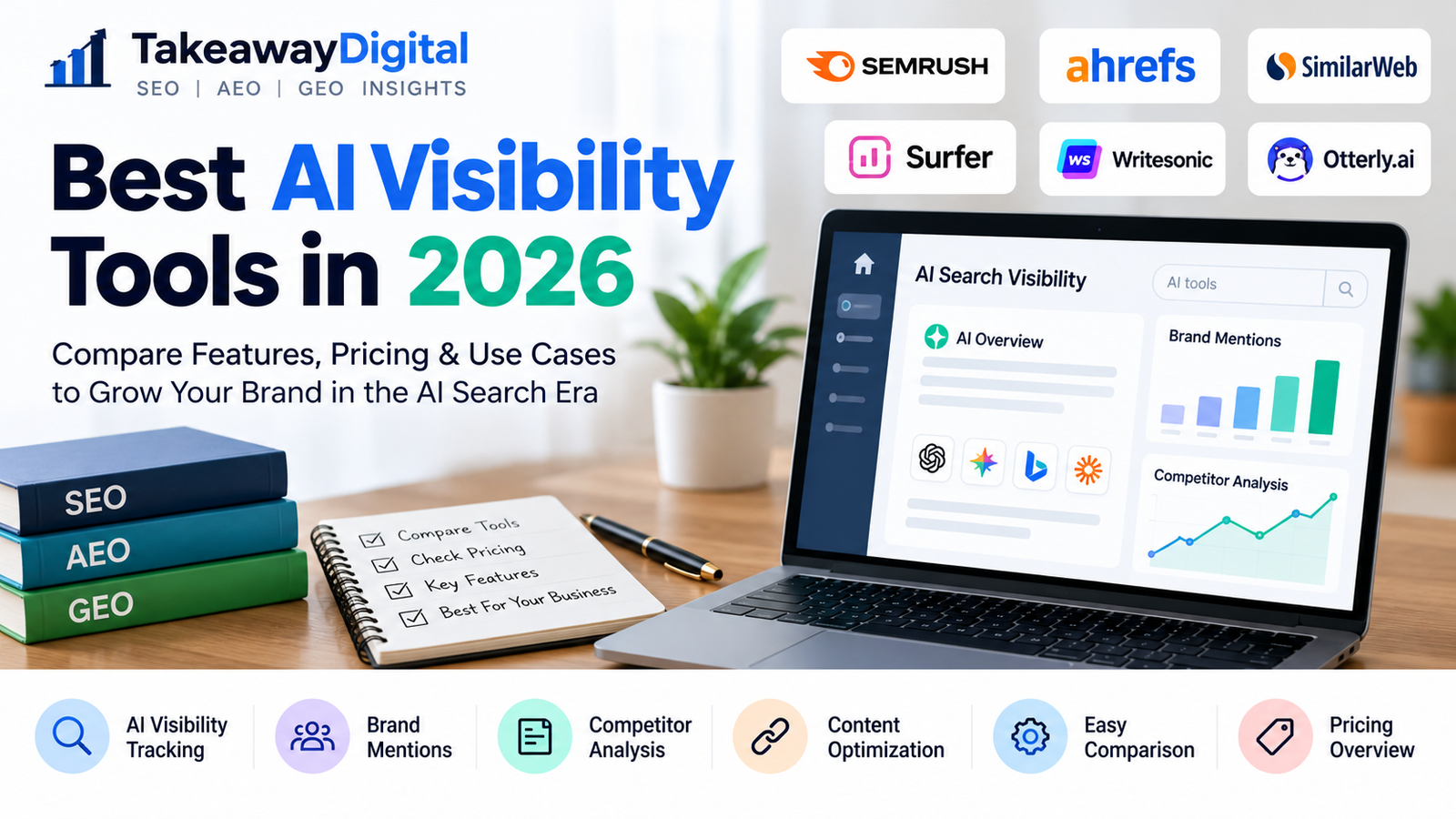
Read our guide to AI Visibility Tools in 2026 for more information about monitoring brand mentions and visibility in AI search.
You can also explore our SEO and digital marketing services, About TakeawayDigital, and Contact TakeawayDigital pages.